How it works
The services
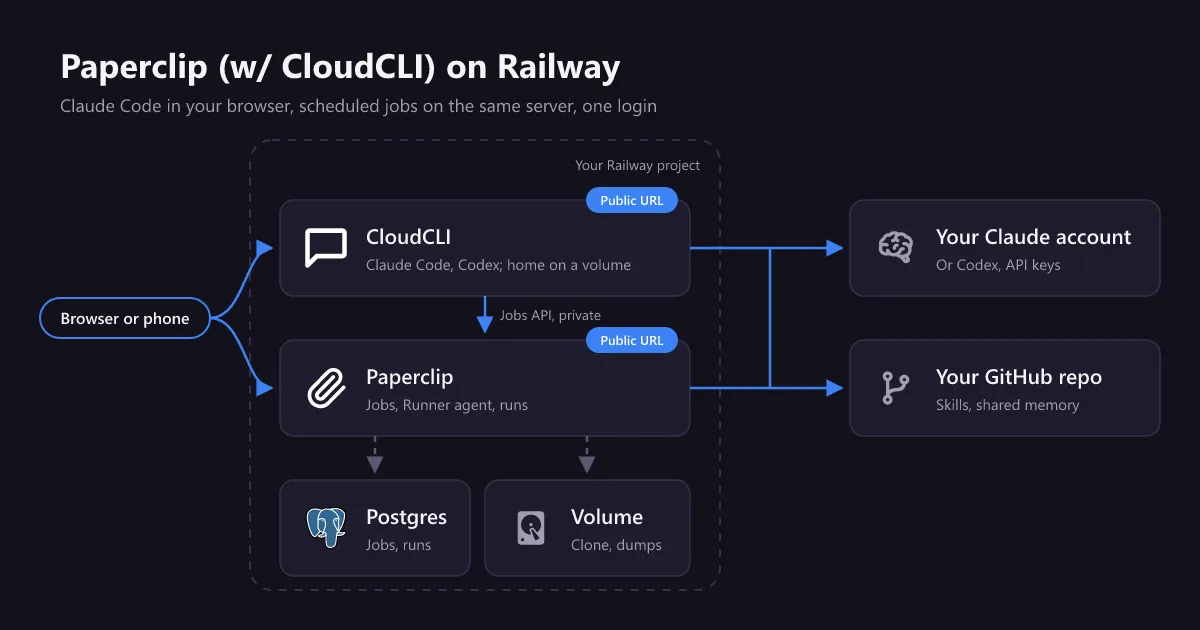
Section titled “The services”Your Railway project has three services.
| Service | What it does | Address | Kept on a volume |
|---|---|---|---|
| CloudCLI | Claude Code (and Codex) in your browser, the /setup page, and the scheduled-jobs skill that manages jobs. |
Public | The home folder: sign-ins, chats, repo clones, installed tools. |
| Paperclip | Runs the jobs and keeps every run. Its dashboard shows jobs, tasks, runs and transcripts. | Public | Paperclip’s data: database dumps, uploaded files, its own repo checkouts, plugins. |
| Postgres | Paperclip’s database: jobs, tasks, runs. | Private | The database. |
Both apps use the same login: the email and password from the deploy form. CloudCLI talks to Paperclip’s API over Railway’s private network, with a key the template creates at start.
A job is a schedule plus a one-line prompt naming a skill in one of your repos. For example:
| Part | Example | Where it lives |
|---|---|---|
| Title | Weekday open issues digest | Paperclip, and .claude/jobs.json |
| Schedule | 0 8 * * 1-5 in America/Toronto |
Paperclip, and .claude/jobs.json |
| Prompt | Run the open-issues-digest skill. | Paperclip, and .claude/jobs.json |
| What to do | The steps of the digest | .claude/skills/open-issues-digest/SKILL.md in your repo |
The job’s logic lives in the skill, in git. The job only says when, and which skill. In Paperclip, a job is a routine.
When a job’s time comes:
-
Paperclip opens a task for the Runner agent. The task’s title names the job, and its description is the job’s prompt.
-
The Runner starts Claude Code on Paperclip’s own checkout of the job’s repo. It runs
git pullfirst, so it always uses what is pushed. -
Claude runs the skill the task names, and only that.
-
Claude closes the task in the same run: done with a one-line summary, or blocked with the reason. When a login or token is missing, it says so and stops, rather than looking for credentials.
Paperclip keeps the run: its status, the summary, the full transcript, the model, the tokens and the duration.
The Runner agent
Section titled “The Runner agent”The Runner is the Paperclip agent the template creates for your jobs. It:
- runs Claude Code itself (the
claudecommand), with your Claude sign-in from the setup page; - uses Sonnet by default, which you can change on the Runner’s page in Paperclip;
- wakes only for its tasks, never on a timer;
- follows short instructions the template keeps up to date: pull first, run the named skill, close the task in the same run, keep changes inside the repo, and commit or push only when the skill says so.
An optional second agent, Codex, runs the jobs you give it with OpenAI’s Codex. See Codex.
One Paperclip project per repo
Section titled “One Paperclip project per repo”Each repo you connect on the setup page gets its own project in Paperclip, with the repo as its workspace. A job belongs to one repo, and its runs use a checkout of that repo only.
- The first repo takes the project Paperclip starts with, renamed after the repo.
- Each later repo gets a new project named after it.
- A job goes in the project of the repo you were chatting in when you asked for it.
See Several repos.
What Claude knows in CloudCLI
Section titled “What Claude knows in CloudCLI”At every start, the template writes a short block of instructions into Claude Code’s user settings on CloudCLI (~/.claude/CLAUDE.md). It tells Claude, in every chat:
- what this server is, and which repos are connected;
- that a job belongs to the repo of the current chat;
- that jobs run in Paperclip as the Runner, with links to give you;
- to use the
scheduled-jobsskill for anything about jobs; - your time zone, and the setup page’s address;
- how to explain the server when you say hi or seem unsure where to start;
- what is still missing on the setup page.
The scheduled-jobs skill teaches Claude the rest: how to create and change jobs, record them in git, test them and read their cost.
Paperclip (w/ CloudCLI) is a Railway template by AvgSoft. Paperclip, CloudCLI, Claude Code, Codex and Railway belong to their makers. Template codeDeploy on Railway