
Secrets
Some jobs need a key or a setting: an API key, a webhook address, a chat ID. Their values go in Paperclip, as secrets on the agent that runs the job. Their names go in the job’s record in git.
So a value never passes through the chat or the repo, and a new server knows what to set up.
Add a secret for a job
Section titled “Add a secret for a job”-
Ask for the job as usual. When its skill needs a key, Claude names it, for example
STATUS_WEBHOOK_URL, and records the name with the job (--secrets "STATUS_WEBHOOK_URL"). -
The jobs script says when the agent doesn’t have it yet, and Claude gives you the link:
"Daily uptime check" needs STATUS_WEBHOOK_URL, which Runner doesn't have yet. The user adds it on Runner's Harness / Runtime page in Paperclip (https://your-paperclip.up.railway.app/JOB/agents/<agent id>/runtime): under Environment variables, Add variable, type the name, then choose "Organization secret" and "Create new secret..." for a key or token, or "Text value" for a plain setting such as a chat ID, and Save changes. -
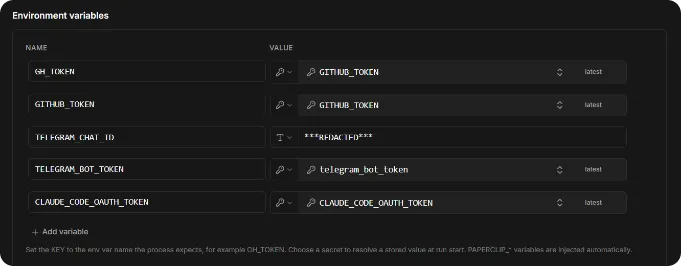
Open that link, or in Paperclip go to Agents, Runner, Harness / Runtime. Under Environment variables, click Add variable and type the exact name.
-
Choose the value’s kind in the small menu next to it:
- Organization secret, then Create new secret…, for a key or a token. Paperclip stores it encrypted, and the page shows only its name.
- Text value for a plain setting, such as a chat ID.
-
Click Save changes.
-
Test the job: “run it now and show me the log”.
Claude never asks for a value in the chat, and never writes one into the repo. Don’t paste one in the chat yourself.
In the record
Section titled “In the record”{ "title": "Daily uptime check", "prompt": "Run the uptime-check skill.", "cron": "0 7 * * *", "timezone": "America/Toronto", "status": "active", "secrets": ["STATUS_WEBHOOK_URL"], "paperclipId": "4c0d9b12-6a5e-4f3b-9d77-2b8e1f0a6c31"}The names follow the job through renames, moves to another repo, sync and restore. To change a job’s list, ask Claude; --secrets "" clears it.
Good to know
Section titled “Good to know”- Secrets belong to the agent, not the job. Every job the Runner runs, in every repo, can read the Runner’s secrets. A name per project, such as
TELEGRAM_CHAT_ID_ACME, keeps settings apart, but not access. For a credential only some jobs should reach, see Outside services. - The template binds its own secrets on the Runner:
CLAUDE_CODE_OAUTH_TOKEN,GH_TOKENandGITHUB_TOKEN, from the setup page’s Claude and GitHub steps. Leave them; the rest are yours and are kept. - Paperclip encrypts secrets with the
PAPERCLIP_SECRETS_MASTER_KEYvariable. Keep it: without it, they can’t be read.
Paperclip (w/ CloudCLI) is a Railway template by AvgSoft. Paperclip, CloudCLI, Claude Code, Codex and Railway belong to their makers. Template codeDeploy on Railway